Turn expanding participation into sustained co-creation.
Chapter 1 establishes sustained co-creation and its public value as the shared direction. Section 2.1 begins with participation and geography; subsequent chapters examine contribution, influence, technical roles and model reuse. This chapter brings that evidence into three shared tasks and nine actions: helping people stay involved, sustaining open assets, and examining actual use and public outcomes.
This chapter returns to the four OSDGs pillars, connecting people, open supply, global connections, governance and public value to shared work. The 29 OSDI indicators provide an observation framework; the follow-up items below support reviews of action rather than an additional composite score.
This chapter develops action directions from earlier evidence, preserving each section’s scope and period. Implementation and outcomes require continued examination in specific projects and local contexts.
Download Chapter 6 PDF · Chinese, 11 pages ↓6.1 Findings and outlook
How can growing participation support lasting collaboration and public value?
The first five chapters examine who can participate, what they contribute, which actors and technical roles connect that work, and how open assets support further creation. Together, they point to the need to develop participation pathways, maintenance responsibilities and conditions for use. Scale, rank and openness each offer evidence; sustained co-creation requires following people, assets and their use over time.
6.1.1 Multiple centres of participation need lasting collaboration
Section 2.1 records about 28.9036 million active GitHub developers in the 2026 reporting year, with India, Brazil and Indonesia together accounting for about 18.2%. In the editorial team’s five-group statistics, the United States, Europe and China each approach 30 million developers in total. These distinct observations show both established centres and expanding sources of participation.
Platform coverage affects whose participation is visible. Section 2.1 reports the domestic-platform supplement separately in country comparisons while retaining the scope of its five-group series. Research should improve coverage and deduplication. Action should connect participants through regional nodes, real tasks and mentoring, including Global South partners in maintenance and decisions. Following the same participant cohorts is necessary to assess whether growth develops into lasting contribution.
6.1.2 Locate actors through influence and shared work through technical roles
Chapter 3 locates regions, companies, foundations and projects within collaboration networks. Chapter 4 adds their technical roles: section 4.1 connects application entry points with runtime, evaluation and tooling through its Agent Infra and Model Infra categories and monthly observations. The landscapes in sections 4.2–4.6 provide entry points for further research in other fields.
The resulting action priority is to establish shared dependencies from actual use, then examine maintainers, workload and support gaps. Rankings can identify subjects for investigation and categories can clarify technical roles. Resource allocation still requires concrete evidence of dependencies, maintenance and use. Both leading projects and smaller foundational components may need sustained work across organizations.
6.1.3 Growing supply and reuse require version-specific openness
Chapter 5 connects supply, reuse and openness. In section 5.1’s reconstruction from a single snapshot, model counts grow by 58.3% and publishing accounts by 48.4%. Section 5.2 examines declared derivation networks and influence. Greater supply widens choice; further creation also depends on clear upstream relationships, versioned materials and conditions of use.
Among the 870 models examined in section 5.3, 600 are classified as highly open, of which 117 also have high completeness; the remaining 483 have completeness gaps. This difference points to the need to connect licence conditions with code, weights, data documentation, evaluation and maintenance access. The sample supports improving release and review processes. Actual adoption, formal recognition and public outcomes each require their own evidence.
6.1.4 Three shared tasks across actors and fields
Figure 6-1-1 connects these observations to the three shared tasks introduced in Chapter 1. The tasks span the four pillars; actors take distinct responsibilities linked through maintenance, open delivery and feedback from use.
Evidence, shared tasks and responsibilities
Select evidence, a task or an actor to explore connections and recommendations here.
Shared goals need shared responsibilities
Verify dependencies and maintenance owners. Support documentation, evaluation, adaptation and succession; record versions and upstream relationships for further use.
Select a node to inspect its evidence, task or recommendations.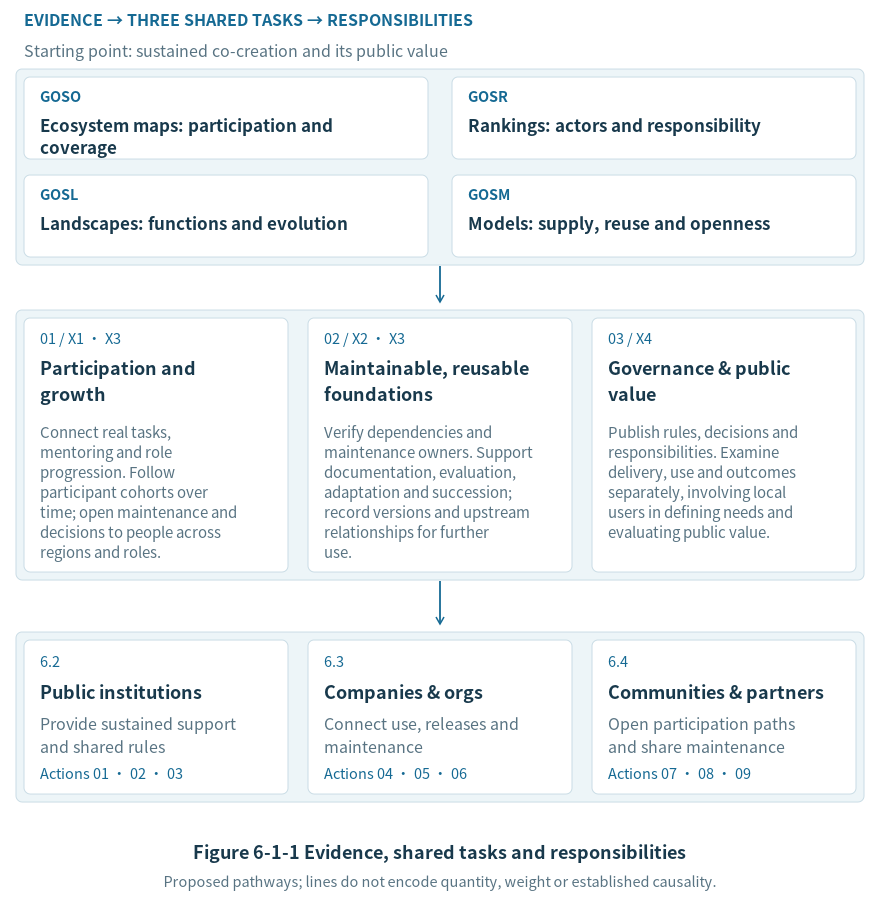 Download complete static SVG ↓
Support sustained participation and talent development
Connect real tasks, mentoring and role progression. Follow participant cohorts over time; open maintenance and decisions to people across regions and roles.
Build maintainable, reusable open foundations
Verify dependencies and maintenance owners. Support documentation, evaluation, adaptation and succession; record versions and upstream relationships for further use.
Advance transparent governance and verifiable public value
Publish rules, decisions and responsibilities. Examine delivery, use and outcomes separately, involving local users in defining needs and evaluating public value.
The nine recommendations explain why to act, who should take responsibility and how to review progress. Begin with a defined population, baseline and observation period, then record inputs, processes and outcomes. Follow-up within a comparable scope can improve support; comparisons across regions should retain differences in platforms, samples and time periods.
6.2 For Governments and international organizations
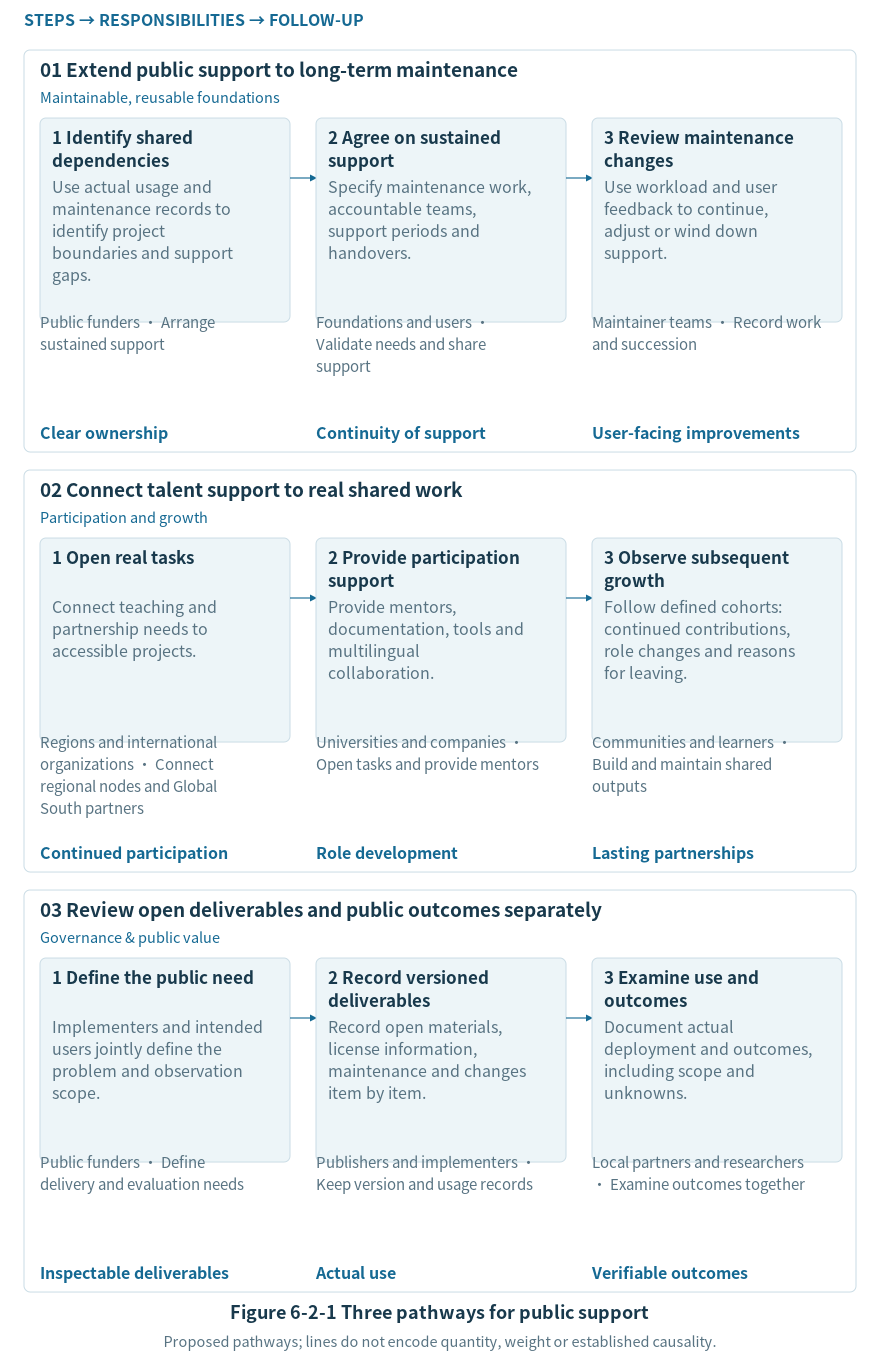
Public bodies and international organizations can improve conditions for lasting collaboration. Section 2.1 highlights established centres, expanding participation and platform coverage; Chapters 3 and 4 help locate potential partners. Public support should verify needs and address maintenance, participant growth and public outcomes. Figure 6-2-1 presents the three action pathways.
Three pathways for public support
Choose a recommendation to inspect its steps, responsibilities and follow-up observations.
Identify shared dependencies
Use actual usage and maintenance records to identify project boundaries and support gaps.
Agree on sustained support
Specify maintenance work, accountable teams, support periods and handovers.
Review maintenance changes
Use workload and user feedback to continue, adjust or wind down support.
Named maintainers and handover plans for priority dependencies
Confirmed resources compared with actual maintenance needs
Responses, releases and user feedback within a consistent scope
 Download complete static SVG ↓
6.2.1 Extend public support to long-term maintenance
Chapters 3 and 4 help locate actors and technical roles. Setting support priorities also requires evidence of actual dependencies, maintenance burdens and existing resources.
Public funders, foundations, users and maintainers should establish a scoped list of priority projects. Support maintenance, documentation, testing, adaptation and security fixes, with named owners, funding periods and succession arrangements. Review continued usability. Mature infrastructure and emerging communities may require different support arrangements.
Clear ownership — Named maintainers and handover plans for priority dependencies; Continuity of support — Confirmed resources compared with actual maintenance needs; User-facing improvements — Responses, releases and user feedback within a consistent scope.
6.2.2 Connect talent support to real shared work
Section 2.1’s multiple centres and regional examples identify opportunities for collaboration. Scale describes the participation base; talent support should also follow the same people as they contribute and take responsibility.
Regions, universities, companies and communities should open real tasks in existing projects, with mentoring, tools and continued feedback across documentation, translation and evaluation roles. International organizations can connect Global South partners with peers, support remote, multilingual and asynchronous work, and involve local partners in task design. Follow defined cohorts and periods, recording continued contributions, role changes and reasons for leaving.
Continued participation — Follow-up activity of the same first-time participant cohort; Role development — Paths from first tasks to review and maintenance; Lasting partnerships — Cross-region tasks and continued maintenance records.
6.2.3 Review open deliverables and public outcomes separately
Chapter 1 distinguishes goals, indicators and evidence; section 5.3 separates completeness from licence openness. Public support should connect these conditions to actual use and outcomes.
Public funding and pilots can specify open materials, maintenance and the public needs to address. Check delivery by version, record use by deployment, user group and operating period, and evaluate outcomes with local implementers, intended users and researchers. International cooperation can share documentation and review methods. Verify formal recognition under its applicable rules, keeping the evidence for each layer distinct.
Inspectable deliverables — Record applicable materials, checked items and unknowns separately; Actual use — Deployment, intended users and continued operation records; Verifiable outcomes — Outcome evidence with methods and time periods.
6.3 For Companies and organizations
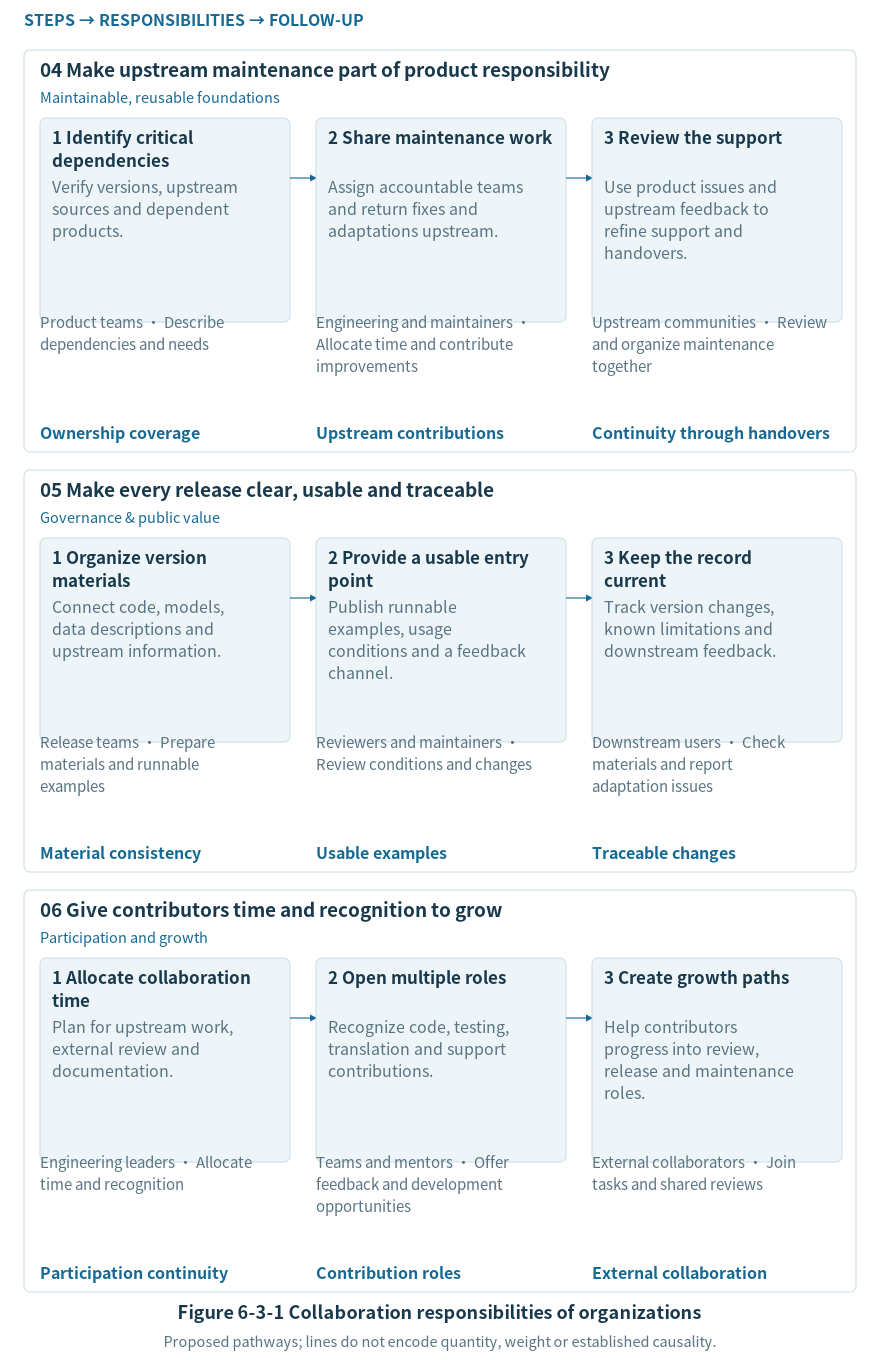
Companies connect product use, open releases and upstream maintenance. Chapter 3 examines organizational participation; Chapters 4 and 5 add technical roles and reuse. These connections should inform engineering budgets, responsible teams and version records. Figure 6-3-1 links product responsibilities, open releases and contributor development.
Collaboration responsibilities of organizations
Choose a recommendation to inspect its steps, responsibilities and follow-up observations.
Identify critical dependencies
Verify versions, upstream sources and dependent products.
Share maintenance work
Assign accountable teams and return fixes and adaptations upstream.
Review the support
Use product issues and upstream feedback to refine support and handovers.
Critical dependencies with named owners and plans
Distinguish submitted, discussed and accepted improvements
Maintenance and migration plans after staffing changes
 Download complete static SVG ↓
6.3.1 Make upstream maintenance part of product responsibility
Chapter 4’s technical roles and section 5.2’s reuse networks show how products and models build on earlier assets. Adoption relationships should be connected to maintenance responsibilities and returning improvements.
Engineering and product teams should verify versions and upstream sources for key code, models and data, distinguishing confirmed dependencies from those needing review. Assign contacts and working time; return fixes, tests, adaptations and documentation, separately recording submission, discussion and acceptance. Preserve maintenance, migration and handover arrangements through product and personnel changes.
Ownership coverage — Critical dependencies with named owners and plans; Upstream contributions — Distinguish submitted, discussed and accepted improvements; Continuity through handovers — Maintenance and migration plans after staffing changes.
6.3.2 Make every release clear, usable and traceable
Section 5.3’s sample shows that open licence conditions still need complete materials. Clear releases help downstream users determine how to run, examine and improve an asset.
Organize code, weights, data documentation, evaluation conditions, licences and upstream declarations by version, marking provided, unverified and inapplicable items separately. Document the environment, resource needs, limitations and maintenance access alongside runnable examples. Update the dossier through review and user feedback, keeping materials, licences and changes aligned. Public applications also require evidence of use and outcomes.
Material consistency — Whether materials and licenses match the same version; Usable examples — Reproduction records in the stated environment; Traceable changes — Update dates, known limits and issue handling.
6.3.3 Give contributors time and recognition to grow
Section 2.1 moves from participation towards lasting collaboration, while Chapter 3 examines corporate participation. Organizational support should provide contributors with time, feedback and opportunities to grow.
Include upstream work, external review and documentation in engineering plans, with responsible teams and allocated time. Recognize testing, translation, support and release work, and provide stable contacts for universities, small teams and individuals. Assess contribution content, collaboration quality and sustained responsibility, following role progression within the same contributor cohorts.
Participation continuity — Subsequent contributions and maintenance by the same cohort; Contribution roles — Whether work beyond code is recorded and recognized; External collaboration — Whether external feedback, review and maintenance relationships persist.
6.4 For Communities and global cooperation
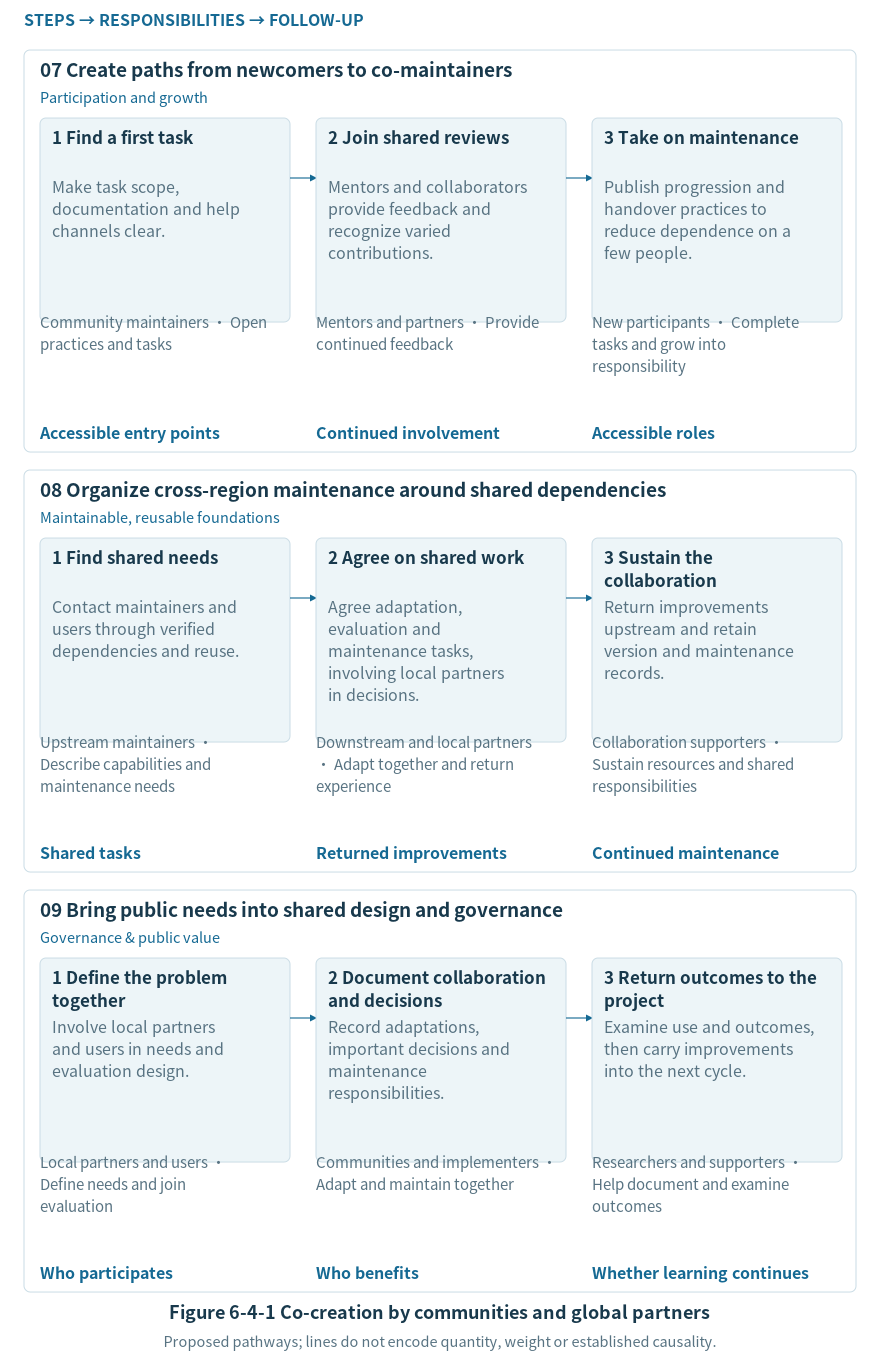
Global cooperation rests on people in different regions working together on shared problems over time. Section 2.1 shows substantial participation in the Global South and opportunities to connect partners through regional nodes. Communities can open tasks, review and governance to wider participation and bring local needs into development. Figure 6-4-1 connects entry, joint maintenance and shared evaluation.
Co-creation by communities and global partners
Choose a recommendation to inspect its steps, responsibilities and follow-up observations.
Find a first task
Make task scope, documentation and help channels clear.
Join shared reviews
Mentors and collaborators provide feedback and recognize varied contributions.
Take on maintenance
Publish progression and handover practices to reduce dependence on a few people.
Whether tasks, documentation and help can be found in practice
Follow-up contributions and departure reasons for fixed cohorts
Records of newcomers entering review and maintenance
 Download complete static SVG ↓
6.4.1 Create paths from newcomers to co-maintainers
Section 2.1’s growth and geography show expanding sources of participation. Keeping people involved requires discoverable tasks, continued feedback and clear routes to greater responsibility.
Start with clearly scoped first tasks, multilingual documentation, asynchronous communication and mentoring. Publish review and maintainer succession rules. Include code, documentation, translation and user support in progression paths. Track defined cohorts at project-appropriate intervals, such as three and six months after joining, and record reasons for leaving to improve entry and collaboration conditions.
Accessible entry points — Whether tasks, documentation and help can be found in practice; Continued involvement — Follow-up contributions and departure reasons for fixed cohorts; Accessible roles — Records of newcomers entering review and maintenance.
6.4.2 Organize cross-region maintenance around shared dependencies
Section 2.1 helps identify regional partners, while Chapters 4 and 5 help identify shared technical work. Cooperation should establish actual dependencies, common needs and lasting responsibilities.
Along upstream and downstream relationships, maintainers and local users can jointly select compatibility, adaptation, evaluation or documentation tasks, agreeing delivery, review and continued maintenance. Enable partners in less-resourced regions and the Global South to shape tasks and important decisions. Retain version, contribution and upstream-feedback records, and review whether cooperation lasts beyond events and personnel changes.
Shared tasks — Joint work with defined objects, roles and deliverables; Returned improvements — Specific upstream feedback, discussion and acceptance records; Continued maintenance — Collaboration across versions and staffing changes.
6.4.3 Bring public needs into shared design and governance
Chapter 1 establishes public value as a shared direction; earlier indicators offer different layers of observation. Users, implementers and maintainers should jointly examine whether a specific asset addresses a need.
Start with a specific local need and involve intended users in defining the problem, testing and evaluation. Publish important decisions, feedback handling and maintenance responsibilities; record participation, scope of use, benefits and limitations. Return adaptation experience and evaluation feedback upstream, connecting public applications to further versions and shared work.
Who participates — Actual participants in needs, design and decisions; Who benefits — Real use and benefit records within a defined scope; Whether learning continues — How local feedback enters upstream releases and maintenance.
6.5 Closing: a sustainable digital future
How can this report itself become part of sustained co-creation?
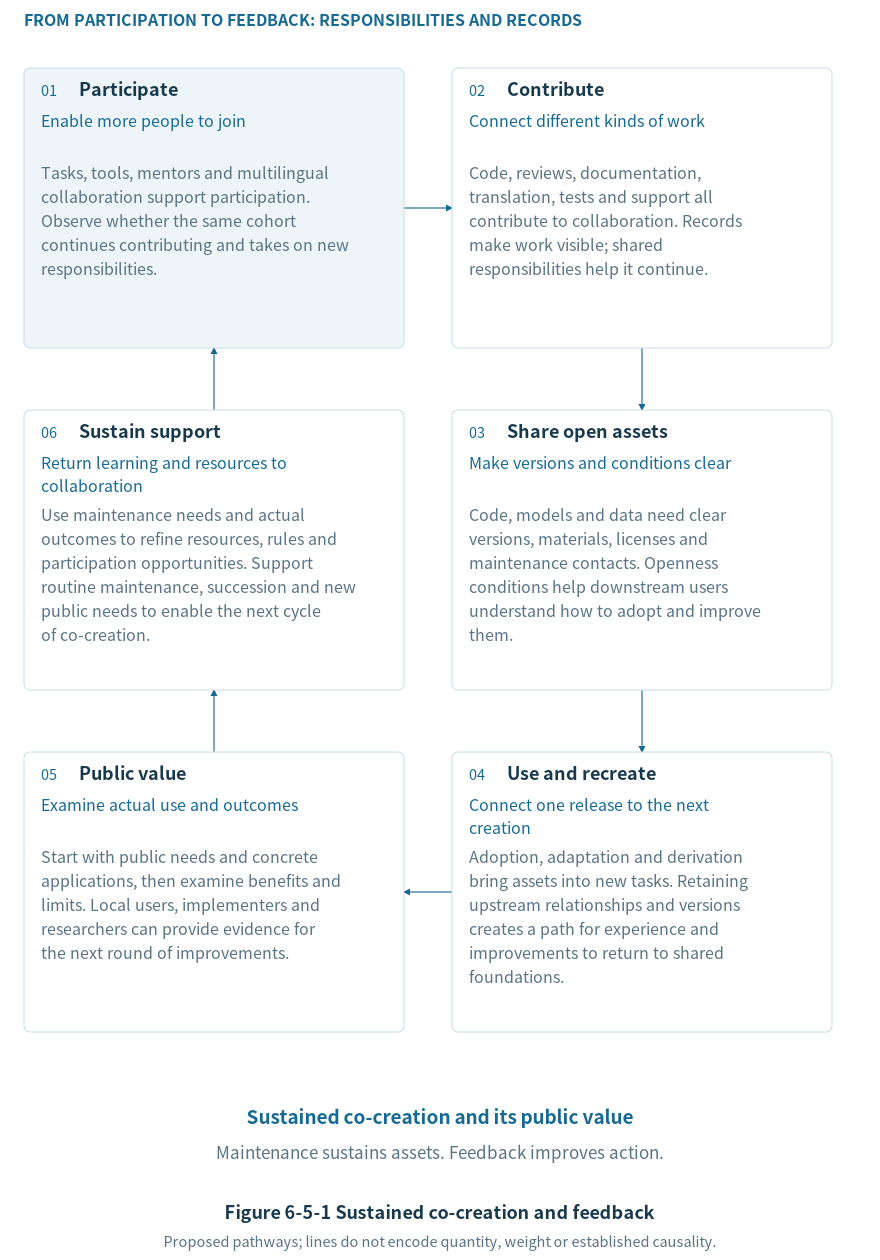
The outlook should become a set of questions that can be followed over time: does participation develop into contribution, does contribution sustain maintenance, are open assets used, and does that experience improve subsequent work? Figure 6-5-1 expresses this feedback relationship. Each stage needs responsible actors and records, including interruptions and departures that can inform improvement.
Sustained co-creation and feedback
Select a stage to explore how participation, assets, use and support connect.
Sustained co-creation
and its public value
Maintenance sustains assets.
Feedback improves action.
Share responsibility,
examine progress
Enable continued participation, maintain and reuse open assets, and use actual experience and outcomes to improve the next round of support.
 Download complete static SVG ↓
Action can begin with a clearly scoped joint project. Agree needs, a baseline and responsibilities, record inputs, delivery and use, and review together at agreed intervals. Examine continued participation, maintenance issues addressed and evidenced outcomes, then decide whether to continue, adapt or conclude support. Choose observations appropriate to project maturity rather than imposing a common threshold across regions and fields.
The next research cycle should strengthen three evidence chains. For participation, extend section 2.1’s platform and geographic coverage and connect it to cohort-level contributions and roles. For assets, verify organizations, projects, models, versions and upstream relationships, linking technical categories to documented maintenance and adoption. For public value, record participation, benefits and limitations in actual applications. Keep unknown, unchecked and simulated elements clearly identified as evidence improves.
This makes the report part of shared work. Governments and international organizations improve support conditions; companies connect use and maintenance; communities and local partners open participation and governance; researchers verify change and its interpretation. Together, these efforts help open assets endure beyond a release, project or reporting year and support further creation.
Our ultimate concern is that more people can remain involved, that shared creations can be maintained, reused and developed, and that their public value can be explained, examined and sustained.
Sustained co-creation and its public value