This report takes the Declaration on International Cooperation in Open Source and Artificial Intelligence as its starting point. Its seven principles—open interconnection, security and trust, data ethics, diversity and inclusion, global collaboration, green intelligence, and inclusive open source—set out a shared vision for an open, inclusive and sustainable AI ecosystem.
The Global Open Source Development Report 2026 connects that vision to evidence and action: who can participate, how shared assets are maintained and reused, and how collaboration can create verifiable public value. The declaration below provides the report’s value foundation; the following chapters examine goals, evidence and responsibilities.
The declaration sets out a shared vision and principles for action; the report develops its judgments from specific evidence. The two are connected, with aspirations and research findings presented distinctly.
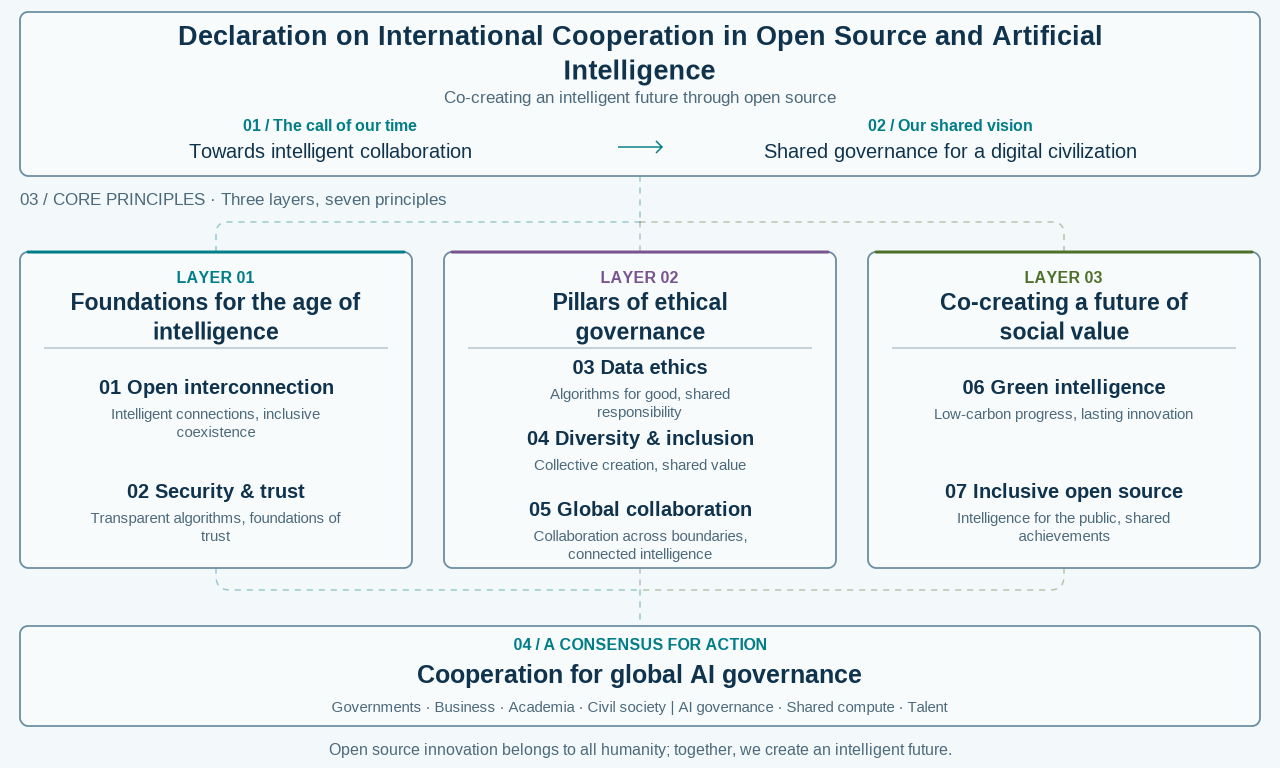
Declaration on International Cooperation in Open Source and Artificial Intelligence
Co-creating an intelligent future through open source: towards a new era of global AI governance
English translation prepared for this report.
I. The call of our time: towards a new era of intelligent collaboration
We stand at a pivotal moment in humanity’s transition from connected computing to intelligent coexistence. The rapid growth of artificial intelligence, particularly large models and AI agents, is reshaping the global economy and society at unprecedented depth. Yet the global intelligence divide continues to widen, competition over technological sovereignty is intensifying, and data silos and algorithmic black boxes hang over humanity like a sword of Damocles. Faced with climate change, public health challenges and complex international relations, we must uphold open sharing and collaborative governance to ensure AI serves the public good and to prevent inequalities arising from technological monopolies.
We—representatives from the Government of China, leading technology companies, international academic institutions, open source foundations and the global developer community—hereby issue this declaration. Guided by a spirit of openness, we call for cooperation through multilateral platforms such as the World Artificial Intelligence Cooperation Organization (WAICO) to build and share a fairer, more transparent and sustainable intelligent future.
This declaration proposes a global framework for open source AI action: digital infrastructure as its foundation, substantive contributions and ethical governance as its pillars, and the realization of social value as its mission. It seeks to make open source software a central force for sustainable development in the age of intelligence.
II. Our shared vision: a digital civilization of shared intelligent governance
We are committed to an open, inclusive, secure and sustainable global open source AI ecosystem, so that powerful intelligent technologies serve the wellbeing of all humanity.
We believe that open source is about building trust as well as sharing code. In the era of generative AI and large models, open source forms the underlying architecture of global digital public goods. Diverse participation, transparency and explainability, and contribution-oriented collaboration are essential for technological innovation to advance peace, prosperity and sustainable development.
We jointly advocate incorporating open source innovation into global digital public goods strategies as a key pathway towards the 2030 Agenda for Sustainable Development, helping build a digital civilization of shared governance, shared benefits and mutual progress.
III. Core principles: a framework for action
Layer one: foundations for the age of intelligence
01Principle 1: uphold open interconnection
“Intelligent connections, inclusive coexistence”
Break down algorithmic barriers and language obstacles, and promote cross-cultural interaction through multimodal models. Encourage localized large models that support multiple languages and uphold non-discrimination in technological development. Enable developing countries to access global AI resources on equal terms, making technological connections a bridge across the digital divide rather than a means of deepening inequality.
02Principle 2: uphold security and trust
“Transparent algorithms, foundations of trust”
Oppose internet fragmentation and technological closure. Support open source as a preferred testing ground for verifying algorithmic safety and detecting data bias. Establish trustworthy, resilient and sustainable AI supply-chain security mechanisms, ensuring the neutrality and stability of critical infrastructure and a secure foundation for the global intelligent society.
Layer two: pillars of ethical governance
03Principle 3: uphold data ethics
“Algorithms for good, shared responsibility”
Uphold data privacy and algorithmic fairness, and guard against technological misuse. Promote inclusive, agile and responsible AI governance. Encourage open source communities to explore best practices in explainable AI (XAI), ensuring that every AI decision is traceable and auditable and consistently serves human dignity and rights.
04Principle 4: uphold diversity and inclusion
“Collective creation, shared value”
Respect cultural diversity and differences in cognitive abilities, and oppose all forms of algorithmic discrimination. Pay particular attention to the rights and interests of vulnerable groups in the age of AI, empowering marginalized communities through open source projects. Support diverse developer communities so that every voice can be heard and respected as intelligent technologies evolve.
05Principle 5: uphold global collaboration
“Collaboration across boundaries, connected intelligence”
View open source as a network connecting global knowledge. Support research and development across national and institutional boundaries, particularly in addressing global challenges such as climate change and biomedicine. Promote the free flow of knowledge, computing resources and high-quality datasets, strengthen South–South cooperation and multilateralism, and build a decentralized yet interconnected innovation ecosystem.
Layer three: co-creating a future of social value
06Principle 6: uphold green intelligence
“Low-carbon progress, lasting innovation”
Prioritize open source AI projects addressing climate change, environmental protection and clean energy. Advocate efficient model-training approaches and optimized computing-resource scheduling to reduce AI’s carbon footprint. Promote open source technology as a core means of delivering digital public goods, with widespread applications in energy management and environmental monitoring, ensuring that intelligent technologies do not advance at the expense of the environment.
07Principle 7: uphold inclusive open source
“Intelligence for the public, shared achievements”
Promote the widespread use of open source technologies in public administration, public health and equitable education, supporting modern governance and improved livelihoods. Encourage open source as a vehicle for digital public goods and establish contribution-oriented incentives, so that innovation benefits everyone, especially marginalized communities.
IV. A consensus for action: towards a new framework for global AI governance
We call on governments, technology companies, academia and civil society to work together, using this declaration as a foundation for practical cooperation in AI governance, shared computing resources and talent development, and to pursue early results.
We support dialogue through the United Nations and relevant international mechanisms on urgent issues including AI ethics, cross-border data-flow rules and AI copyright protection. We seek to build consensus and make open source a practical contribution to a fair and equitable system of global AI governance.
Closing
Open source expresses our commitment to openness, our belief in human solidarity and our shared pursuit of a better world. Let us replace division with collaboration, respond to doubts with transparency and counter monopoly through sharing. Together, let us build a more open, equitable and sustainable intelligent civilization.
Open source innovation belongs to all humanity; together, we create the intelligent future.
From shared vision to evidence and action
This report responds to the declaration through the theme “From inclusion to quality, from participation to impact.” OSDGs articulate development goals; OSDI organizes the evidence. Ecosystem maps, influence rankings, technology landscapes and model observations examine shared creation from complementary perspectives, leading to three shared tasks and nine actor-specific recommendations in Chapter 6.
The declaration sets out aspirations; the report examines progress and gaps through evidence. We seek to enable more people to participate, sustain the maintenance and reuse of shared assets, and support sustained co-creation and its public value.
The declaration follows the text retained in the report; designated source. The English text is a translation prepared for this report.